Showing posts with label Educational technology. Show all posts

Monday, April 8, 2013

Wifi in schools

Should schools be installing wifi to enable the use of wireless devices? My answer is no, but this is a hot topic with a lot to think about.

Recently the BC Teachers Federation contemplated some motions at their annual general meeting on this subject. This follows motions passed by the BC parent group, BCCPAC, which calls for at least one wifi free school in every district. Another group of parents, in York Region District in Ontario, set up a picket to protest the installation of wifi.

The discussion about wifi is about more than just health, although health is at the centre of the debate. Those opposed to the installation of wifi are concerned there are health risks and that our current knowledge of the health implications are incomplete but worrisome enough to act in a precautionary way.

First, on the science and health.

1. There are peer reviewed research papers that support the claim of health risks of wifi radiation (even low levels), and there are peer reviewed research papers that dispute the claim. For a listing of papers concerning health and learning implications, see #wifistudy on twitter, for example.

2. The science, and the evaluation of the science, is not conducted in a neutral environment. There are many large corporate interests  promoting the safety of wifi. Some of the research is directly funded by these interests. I probably don't need to convince anyone that CISCO and Apple and SMART Technologies spend money to promote educational technology. But beyond the direct, there is a vast web of indirect influence.

Thousands of individuals have a direct personal interest in the use and expansion of technology in schools, and this includes wireless technology. For example, the TIE lab, at the University of Victoria, has as its primary research focus the use of technology in learning environments. The people and students who work at that lab have a pre-determined starting point: that there is value in spending resources to investigate and expand the use of technology in learning. Here is their statement of purpose:

The purpose of the TIE lab is to strengthen research excellence regarding the appropriate use of networked and computer‐mediated technologies for enhanced communication, learning, and motivation across educational, professional, and health sectors. The TIE lab provides state‐of‐the‐art Infrastructure for systematically researching optimal e‐learning conditions, tools, processes and products. TIE Lab infrastructure will be used for research purposes only. Research conducted through the TIE Lab will help to maintain Canada’s ranking as a leader in the field of innovation and technology.

Evident is that prior to any research taking place, the goal is to "lead" in "innovation and technology". Absent is any questioning about the value of technology in the first place, or what the technology will displace.

The BC government has also been instrumental in promoting a vision of education reform based on technology integration and expansion. This vision was first articulated in the Premier's Technology Council paper. It is used to justify the promotion of "edtech" throughout the public education system in BC. This happens in direct and indirect ways.

For example, there are several publicly funded institutions who promote edtech. One is BCCAMPUS, which develops technology "solutions" for post-secondary institutions in BC. Here is there statement of purpose:

BCcampus is a publicly funded organization that uses information technology to connect the expertise, programs, and resources of all B.C. post-secondary institutions under a collaborative service delivery framework. We provide valued services to institutions, ensuring B.C. learners, educators, and administrators get the best, most effective technologies and services for their learning and teaching needs.  We provide an ICT infrastructure for student data exchange, shared services, online learning and distance education, communities of practice and online resources for educators.

Needless to say, they also don't seem to do much to question the value of technology enhancement and integration. It is a given that it is good.

In the K-12 world, we have ERAC. Schools and Districts can choose to join ERAC and access their group software purchasing agreements. But they do more than this:

ERAC also provides leadership in the areas of new technology and new media and their potential roles in education. We provide educators with research-based trends and also encourage sharing of knowledge and experience within the membership.

So public dollars go to ERAC via school Districts to support these edtech initiatives.

I am just scratching the surface, but what is clear is that there is a substantial and growing public/private infrastructure that promotes educational technology. And promotes it on the basis that the starting point for consideration is that expansion of technology in schools is valuable.

People in these positions cannot evaluate the science in a neutral manner. They have an interest. If they are employed in one of these institutions, or have made a career in the world of edtech, they have a personal interest.

3. There is an "attack" atmosphere towards those who conduct research into the risks of wifi and those who are active to make those risks known to the public. Consider, for example, the experiences of one scientist who described the climate for research in this talk at Harvard: http://www.law.harvard.edu/news/2011/11/18_safra-center-cellphone-radiation-corruption.html#.T9YSzQGDl3c

In his lecture, “Protection Against Radiation is in Conflict with Science,” Adlkofer discussed the difficulties he and other scientists face when presenting research on the carcinogenic effects of electromagnetic fields emanating from cell phones. He also discussed the institutional corruption which he says obstructs their research.

Even at the low level of twitter feeds, there is a tendency to paint those concerned with the health effects of wifi as unscientific and irrational.

4. There is fairly wide variation in the response of public health officials. In particular, European health agencies have taken a much stricter approach to setting standards and exposure levels. The Toronto Board of Health produced the following comparison chart:

table 1 Toronto Board of Health 2007

5. Given the factors already listed, we can look back on history and consider how these similar responses impeded a timely reaction against other technologies that had harm to human health, such as asbestos, cigarettes, and lead. There is a pattern of public debate that obfuscates the promotion of public health as the first and most legitimate priority when there are profits to be made.

This is just the health discussion. The next consideration, in my view, is to consider what is to be gained from the use of wifi in schools. Interestingly, this debate takes on many of the same hues. The corporate interests in pushing technology cloud the discussion. There is rarely any meaningful talk about what is lost when technology is introduced. And there is sometimes an almost frenzied attachment to a pro-technology viewpoint.

No doubt those parents in York Region looked at the issue somewhat differently - probably just based on their lived experience. This year, my own daughter came home one day having completed a note taking assignment on an iPad. She had to share with others (although our District spent $340,000 on Apple products last year, there was not a full class set). She and the other students struggled with the awkward typing interface. No doubt the iPad sat in her lap, and no-one warned her of the potential for radiation exposure that even Apple indicated in the product manual for an iPad, that they should be held away from the body. If there is a health risk, is an experience like this worth it?

I laughed earlier this year when someone responded to my tweet about the advantages of outdoor Kindergartens by suggesting that wireless devices were great because they enabled schooling to take place outdoors more easily - just grab your laptop and go. What a statement this is about how we view nature and outdoors - just another place to compute in?

Don't get me wrong - there are many wonderful, advantageous aspects to using computers in education. But far too many people are in far too much of a hurry to adopt new technologies without any thoughtful reasons because the atmosphere of the discussion predisposed an outcome - that technological enhancement is inherently of value.

The wifi debate is no different. It is obscured by bias, conflict of interest and corporate influence. Given this, I choose precaution.

Saturday, March 9, 2013

Why educators should resist educational technology

I sat down earlier this week to write a blog post and I had a catchy title in mind: "iPads in the Classroom: Deja vu all over again". I had just read an article tweeted to me by my friend Tobey Steeves that appeared in the Atlantic in the mid-1990's. The article is called "The Computer Delusion" and I would recommend it (http://www.theatlantic.com/past/docs/issues/97jul/computer.htm).

It begins with a short history lesson on past technological advances meant to revolutionize teaching, learning and schools, like television. And how these did nothing of the sort. And I thought, yes, just like the current crop of fad technologies: Smartboards, iPads, MOOCs. My partner had just laughingly told me about how the first out of date and now useless Smartboard showed up in his school's staffroom - the general repository of ed tech junk.

But the more I think about it, the less I think it is the same all over again.

It is very true that since schooling and technology there has been technology in schools. Some technology is very helpful. Some does genuinely change the way we teach and learn, a little bit. And lots gets left in the dust bins of staff rooms for a whole variety of reasons well articulated in The Computer Delusion.

However, just like everything else in society lately, what is different now is not the perpetual change and the perpetual adoption of change before there is evidence to support the change. What is different is the pace of change. Things are happening so fast no-one has time to even reflect on what went wrong.

In Education Week an article on educational technology happily examined "adaptive content". "What if, for example, we designed MOOCs (massive online courses) that, when illustrating a principle during a lecture, could use examples which were designed for the student's context? After all, most online communities already require members to fill in their age, location, etc. Or, if we had webcams that would interpret student's emotions and speed up / slow down a lecture/provide more illustrations/segue to an activity as needed. This technology, in fact, is already used by marketing companies to score consumer's reactions to their products online by reading their facial expressions via webcam, instead of written/multiple-choice feedback."

I don't know about you, but that creeps me out on a lot of different levels. Learning as social activity? No.  Learning to broaden your horizens? No. Learning without privacy intrusions? No. But from one point of view, why not, if that is the fastest and cheapest way to make human beings learn and fast and cheap are the criteria?

About five years ago I was teaching Information Technology and one of the classes I taught was game design. A researcher from the local university came to study my class, interested in how "gamification" related to learning. I didn't think all that much of it at the time, but am starting to see that educational technology is no longer just about tools to enhance learning, but rather the insertion of some of the most disturbing aspects of marketing into the previously (somewhat) protected world of schools and childhood.

Joel Bakan has written an excellent book called "Childhood under siege". In it he examines some of the ways that marketers have used their techniques to sell toys, create addictive games, and market pharmaceuticals to children. It is disturbing. Those same trends are evident in the pitch to change teaching and learning with technology.

One of the words that really bothers me right now is "engagement". It is so trendy. You can't have a conversation or read an article about education without encountering it. But what does it really mean?

Learning is hard. And learning hard things is harder. Learning also is often uncomfortable. And sometimes it is boring. Anyone who has learned to play the violin knows that it takes at least 10,000 hours of often repetitive practice that sounds bad. There is no shortcut. You can play with others, play pieces you like, and perform. These all make it more fun. And you hopefully learn along the way that the practice is worth it. And this is what motivates you to practice more.

What the educational technology companies are pushing is "engaged" learning as a short cut. But it won't work. It won't engage. It won't teach better.

First off, much of what passes for educational technology these days is really modified consumer electronics. iPads, iPhones...these are consumer devices, not educational tools.

Apps and games are designed to addict, not engage. I find apps the most disturbing...the most simplistic human reaction - just touching it - gives you a reward and a little hit of dopamine. You keep playing. Or checking your email. Or your twitter feed. It is this very feature of apps that make them appealing to two year olds. Playing on an iPad is more fun than learning to walk. Why? It is easier. You learn less (if anything at all). That is why they have temper tantrums when you take the iPad away.

Sherry Turkle, in her book "Alone Together", considers the touted advantage of "multitasking" with technology. "When psychologists study multitasking, they do not find a story of new efficiencies. Rather, multitaskers don't perform as well on any of the tasks they are attempting. But multitasking feels good because the body rewards it with neurochemicals that induce a multitasking "high". The high deceives multitaskers into thinking they are being especially productive. In search of the high, they want to do even more. In the years ahead, there will be a lot to sort out. We fell in love with what technology made easy. Our bodies colluded."

App development and consumer electronics are not designed for optimal learning. They are designed for optimal addiction. Very, very clever marketing people put their minds to this. They use everything we know about human psychology. Online pets die for a reason, as Joel Bakan explains in his book. The reason is to cause fear and worry in the child who must return to the program to feed it.

My daughter is 13 years old, and I look around and am thankful I didn't have to keep iPads away from her. How did this happen so fast? She's not even grown up, and already childhood is different, and not for the better. This year in our school District, Wifi will be available to every child in every high school. Why? I don't know. So they can watch youtube at lunch hour instead of hang out with their friends? Respond to their text messages? Check their Facebook? Is it *necessary* or even *beneficial* for learning? I've yet to hear a good reason.

We didn't use to have think about the precautionary principle in education. The popular myth had it that the pendulum would always swing back the other way, protecting us from fads and political interference. But this myth is just that - a myth. For twenty years, from a computer in every classroom to massive online learning, technology companies have become more and more sophisticated at pushing their product. We need to resist before it is too late.


Monday, February 25, 2013

Saying it like it is - Exposing the Premier's Technology Council on #bced

What do teachers do? What should teachers do? Who should decide?

These are some of the questions both posed and answered in the new BC Education Plan and now, thoughtfully examined, by Cory (Tobey) Steeves, a Vancouver teacher. Steeves' work is available online here: https://circle.ubc.ca/handle/2429/43675

In  (De/Re)-Constructing tachers and their work: A Discourse analysis of British Columbia's 21st-century policy, Steeves looks beyond the obvious to uncover some of the "problems" with 21st-century learning. His focus is on British Columbia, and he uses the Premier's Technology Council (PTC) report, A Vision for 21st Century Education as a basis for identifying underlying themes. In the process, he exposes aspects of the agenda to reformulate what teachers do and who controls what they do.

Steeves situates his work in the company of other education theorists who have described the impacts of corporate education reform on what teachers do and who tells them what to do. He uses a discourse analysis to "problematize" these components of the 21st-century agenda. To do this, he looks at certain textual features of the report and identifies elements that match the "learnification" and "accountingization" of education.

"Learnification" is a fancy word for reducing the process of education to just learning. This has the effect of simplifying all educational processes to a singular narrow focus - the outcome of what has been learned. Anyone living in our test obsessed culture can identify with this. For example, this can be teaching to the test so the student will do well on the test. But more generally, it is the process of narrowing not just the curriculum, but all aspects of eduacating, into only what is to be learned. Of course missing then is relationships and socializing, the role of teachers' professional judgement, and a role for society to articulate what education is and is for.

"Accountingization" is also a fancy word more easily described: turning teaching into an activity whose every component part can be itemized, counted and judged. Similar to learnification, the net effect is to influence what teachers do (teach what can be counted) and how they do it (judge them on student test results).

Using this conceptual framework, Steeves goes on to the look at the language used (or not used) in the PTC report. Steeves locates the document within a genre of "management talk" - a perfectly apt description.  By considering some of the language use, Steeves then goes on to identify "managerialist features" in the text, such as this one - a word cloud showing the use of modal verbs:


As he articulates: "the overwhelming emphasis given to "will", "must", and "should" suggest a willingness to determine the roles and vlues of others."

It is a bit of a tough read (I will candidly admit that anything with the word "discourse" in the title usually ends up back on the shelf in my household), but his conclusions and motivation made it worth the wade through some unfamiliar territory. I certainly agree that one aspect of the #bcedplan is that "transnational technology corporations become mingled with the values of teachers, and 'good teaching' is re-imagined as a vehicle for constructing a knowledge-based economy."

I found the emphasis on teaching and teachers was a unique lens to approach this topic. While I typically start from the profit-making intent of technology companies and the incompatibility of this with genuine education (which I equate with human well being, first and foremost), Steeves looks at the same topic through the view of what teachers do and who tells them, and this is refreshing and important. To this end, despite our theoretical differences, I found myself hopeful that I was one of the "friends" in mind in his dedication: "I dedicate this work to the friends of the commons and the defenders of a more democratic otherwise: May it bring you tools for play-and battle."

And since I haven't said it before, to all you readers, friends, fellow activists out there, that is my dedication too.


Tuesday, November 20, 2012

Technology in school? How much is too much

When a parent visits a daycare, top of their minds is what kind of activities their children will be doing. A typical visit includes a description of the day, from play time, to nap time, to out door time. Most day cares proudly announce that they have no or very little screen time - be it television or computers.

But suddenly, the "critical thinkers" in the education policy world think we should be infusing and transforming our schools, including our primary classrooms, with endless numbers of screens and gadgets. Class sets of iPads, BYOD (bring your own device), blended learning...there is a never ending push for more technology in teaching.

Just today I had a look at a slideshow from Brian Kuhn, an IT Manager of School District 43. The show is entitled Brittania Elementary Education Technology Ideas (http://www.slideshare.net/bkuhn/britannia-elementary-educational-technology-ideas-nov2012) and displays the so-called wonders of using digital cameras, smart phones, ipads and laptops in elementary school. While no doubt many of the activities presented are fun, engaging, and involve some learning, nowhere was there a critical look at a most basic question: how much technology is appropriate for children? what are the downsides? at what age? and critically, how much is too much?

Or, to put it visually, do we want schools with more of this:

 (http://www.flickr.com/photos/56155476@N08/6659978347/)

or with more of this:


(http://www.flickr.com/photos/wwworks/3120816179/sizes/m/in/photostream/)


Far away from the education policy makers, other fields of study - notably pediatrics and child psychology - are making some very relevant critiques of the dangers of screen time, particularly for children and teenagers.

Dr. Larry Rosen, writing for Psychology Today, describes a recent study of students:

"Recently my research team observed nearly 300 middle school, high school and university students studying something important for a mere 15 minutes in their natural environments. We were interested in whether they could maintain focus and, if not, what might be distracting them. Every minute we noted exactly what they were doing, whether they were studying, if they were texting or listening to music or watching television in the background, and if they had a computer screen in front of them and what websites were being visited.

The results were startling. First, these students were only able to focus and stay on task for an average of three minutes at a time and nearly all of their distractions came from technology. [By the way, other researchers have found similar attention spans with computer programmers and medical students.] The major culprit: their smartphone and their laptop were providing constant interruptions. We also looked at whether these distractors might predict who was a better student. Not surprisingly those who stayed on task longer and had study strategies were better students. The worst students were those who consumed more media each day and had a preference for working on several tasks at the same time and switching back and forth between them. One additional result stunned us: If they checked Facebook just once during the 15-minute study period they were worse students. It didn’t matter how many times they looked at Facebook; once was enough." (http://www.psychologytoday.com/blog/rewired-the-psychology-technology/201204/attention-alert-study-distraction-reveals-some-surpris)

Dr. Marilyn Price-Mitchell, a developmental psychologist, writes on her web site about the effects on children of over stimulation from television:

"In 1970, the average age at which children watched television was four years old. Today, the average age is four months. The typical child before the age of five is watching 4 ½ hours of television per day, 40% of their waking hours! Recent studies have linked television to the over-stimulation of an infant’s brain, leading to the development of Attention-Deficit/Hyperactivity Disorder (ADHD) in young children."
(http://rootsofaction.com/blog/are-we-over-stimulating-young-children-dimitri-christakis/)

She is referring to studies by Dr. Dimitri Christakis, MD, on the effect of television viewing on children. Dr. Christakis has produced a TED talk on the topic of media and children, and suggests parents need to ensure their children are on a "media diet".


Interestingly, school is one place where children currently escape from their gadgets and screens. But this could be set to change, without much public discussion.

This theme is also taken up by Dr. Stuart Shankar, a Canadian researcher involved in the study of self-regulation, who talks about the effects of stress and over stimulation:

"What we're seeing is a generation of children whose nervous system is essentially being overstimulated."

Reasons included emotional and physiological stressors such as changing marital patterns, parental stress, changes in extended family involvement, increased use of the television, video games and the internet, and exposure to damaging themes via marketing and the media.

"We're concerned about the dramatic increase in television viewing, which is a physiological stressor because so much of the brain's energy is used on visual processing," Dr Shanker says.
(http://au.news.yahoo.com/thewest/lifestyle/a/-/article/13946118/childrens-stress-levels-soar/)

The corporations who stand to make substantial profits from technology in education have spent a decade promoting the "edtech" business. They are single minded - they want as much technology in schools as possible. And they are on the cusp of getting what they want in growing numbers of jurisdictions all over the world. Layers of education policy makers and bureaucrats now mindlessly push technology without any discussion about potential drawbacks or health concerns, but rather just the "more is better" mantra.

Saturday, November 10, 2012

Technology in a 21st Century Learning Inc world

Not surprisingly, technology is almost always identified as a component of 21st Century Learning. But this isn't simply adding new technology to aid in the delivery of curriculum or to allow new teaching methods. It is not a matter of adding a few computer labs or replacing textbooks with eBooks.  In the 21st Century Learning model technology defines the learning methods. It is absolutely backwards - rather than pedagogy defining if and what technologies are used, instead, it is technology driving the choices for learning. As such, it is fundamentally different than the type of technology integration we've seen in the past. It is also, ironically, antithetical to a student-centred or personalized approach because the technology is driving decisions, not student needs.

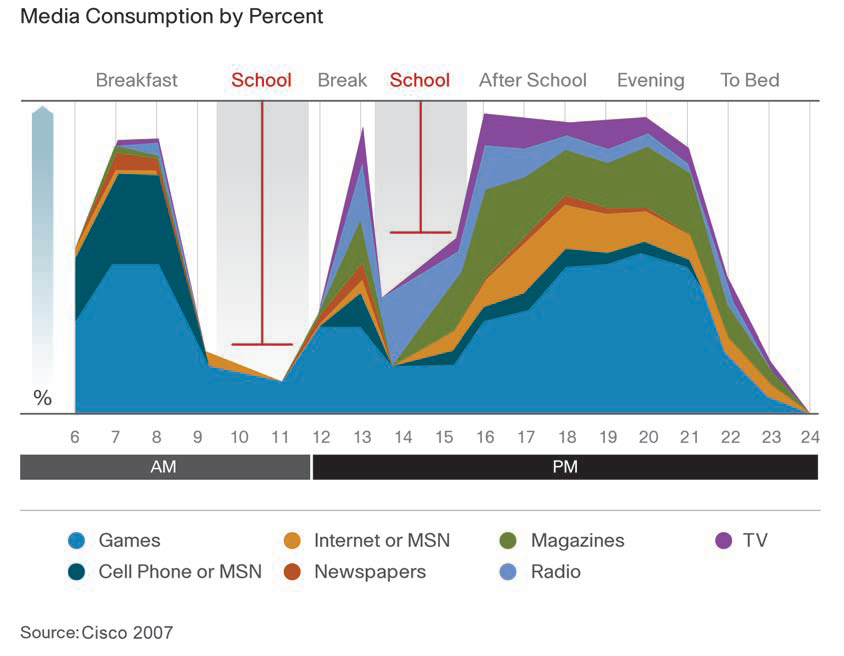
Whole books have been written on the degree to which technology should or shouldn't be in our schools, but we can consider just a few statistics to get a sense of where 21st Century Learning advocates would like to take us. A paper by CISCO provides a helpful chart documenting what media consumption Dutch teenagers do during an average day (
http://www.cisco.com/web/about/citizenship/socio-economic/docs/GlobalEdWP.pdf)


The question CISCO asks is, “How can traditional modes of classroom instruction engage and inspire students when life outside the classroom has changed so dramatically? In 2007, teens in the United States spent 40 percent of their media time on cell phones, the Internet, and games, up from 16 percent in 1998. For many learners, class is the only time in their day  when they completely ‘disconnect.’” Rather than question how much is too much technology, this technology company wonders how we can increase the screen time of teenagers by filling in the one relatively screen free time - school. Meanwhile the Canadian Pediatric Society recommends a two hour screen time limit for children. Significant social issues related to screen time include obesity, mental health and even changing brain chemistry for younger children.

To sell more IT products, the 21st Century Learning advocates create a need for those products. No longer should schools spend their resource and IT budgets only on textbooks and computer labs. Anytime, anywhere, collaborative, integrated, blended learning requires a massive infusion of new IT products.

Considering just one corporate player, Pearson, we see the objectives identified in this report written by Donald Gutstein for the British Columbia Teachers’ Federation:

“According to investment research firm Sanford Bernstein & Co., Pearson is pursuing three  growth strategies. First, the company is investing in content and technology to increase its  market share of the education industry. Second, the company is restructuring away from the FT  Group and reinvesting the proceeds into the high-growth areas of emerging markets (Brazil,  India, China, South Africa) and consumer—rather than publicly—financed education. The third  strategy is new, and Bernstein predicts it will ‘revolutionize how education is delivered to  students around the world, starting with the United States.’ It is an ambitious attempt to  further commercialize education by claiming its products and services will raise student and  teacher performance while at the same time cutting spending. If successful, Bernstein argues,  ‘it would make every teacher and school student in the United States a potential customer’ by  ‘personalizing education in U.S. schools through technology and best practices.’” (
http://www.bctf.ca/uploadedFiles/Public/Issues/Privatization/PearsonGutsteinReport.pdf)

Pearson appears to have the US government firmly in its corner with the launch of the ‘Digital Promise’ announced in 2011. Digital Promise, “will work with leading researchers, entrepreneurs, and schools to identify and spur breakthrough learning technologies that deliver the best results for students, parents, and teachers.” (
http://www.whitehouse.gov/blog/2011/09/16/21st-century-learning-digital-promise)

Without doubt there is a place for technology in schools and classrooms. It is also likely that new technological developments can provide useful tools to enhance learning. Online and blended models certainly have a place to address issues such as geographic distance and schooling in small communities with few children.

What is troubling is that rather than a broad discussion about the potential new uses of technology along with the potential risks and pitfalls, the dialogue is one-sided and misleading.

Tuesday, November 8, 2011

Pearson-alized learning: Guest commentary on #bcedplan

Today's guest post is from David Komljenovic, Kamloops teacher
After researching more about the origins of the BC Education plan and the proliferation of the 21st century learning mantra, I am more convinced that our message could be "BC Public Education is not for sale".
From the information to follow, there is evidence that corporations and primarily one has benefitted from the underfunding and undermining of public education. My sense is that when government attempts to create crisis in education, corporations give the appearance that they need to come and pick up the pieces. Difficult to do in BC which ranks as one of the best in the world. But the BC Ed plan may be the equivalent to the premise of Snobelen's infamous speech on "manufacturing crisis" in Ontario's public education system.
Pearson Education is the largest corporation in the education market (not that there should be a market in public education - but...). With the recent move to provide districts and charter schools in the US with personalized learning options, consider their creep into Canada and BC.
First, consider what Pearson is doing in the field of Personalized Learning (http://www.pearsoned.com/pearson-and-knewton-partner-to-advance-next-generation-of-digital-education/). In the attached article, the company Knewton joined up with Pearson to provide a diagnosis tool for students proficiency (enter Standardized Testing). If you wondered how standardized testing fits with the BC Education Plan, consider the market for standardized tests and how corporations will say that they are just using them as a toold to diagnose learner need so that their program can be personalized. The program is also a product that can be provided by Pearson or Knewton or perhaps another corporation.
Second, Pearson is involved in taking over the international assessments (PISA) that consistently rank Finland, Canada, and South Korea at the top - more egalitarian and/or cooperative systems compared to the rest of the jurisdictions. (http://www.pearson.com/media-1/announcements/?i=1485). What will corporate control of the assessments mean - haven't put my mind to that question but it is a concern.
Then consider that Pearson has taken over BCeSIS. Again, a manufactured crisis - as if BCeSIS was even necessary. It was forced upon districts who spent countless funds and ended up being a failure. Here comes Pearson to the rescue to take over the program to replace it with BCeSIS. Consider this article from the Vancouver Sun: http://blogs.vancouversun.com/2010/11/17/bcesis-and-pearson-education-better-for-teachers/ .  Enter Bill 3 - the attempt by government to eliminate privacy protections that were in place before (https://www.privacyassociation.org/publications/2011_10_21_opinion_bc_bill_could_threaten_privacy/) . The government will have a greater ability to collect information on individual citizens and share the information with other agencies (Homeland Security in the US is a concern - so it providing the information to corporations like Pearson which will have access to the software system with just about all of a student's information anyways).  
In terms of Personalized Learning in BC (which is the BC Education Plan), Pearson has already met with various districts to help provide services. Consider this article: http://www.pearsonschoolcanada.ca/index.cfm?locator=PSZqH7.
The icing on the top for government, they can say all of this necessitates them gutting our collective rights and have us worry about that while they are accelerating the sale of public education. But the real agenda, in my mind, is having corporations come in and provide (and control) funding where the government (and really the people of BC) should be stepping in.
Educational philosopher John Dewey stated "Democracy must be born anew in each generation, and education is its midwife". Media control in Canada is a concern in that few corporations control a fair bit of information, but education is all about thought. Personalized learning as a marketed program that is provided by one or two major corporations will provide one or two versions of thought - which is why the fight for professionalism is more important now than ever before.  
So while teachers have been told we cannot wear buttons or place materials on bulletin boards to express thought, a major corporation will soon have unlimited access to children for what reason other than to exploit (consider the premise in the film "The Corporation" http://en.wikipedia.org/wiki/The_Corporation_(film).

Pearson's drive to control the world's educational needs cannot help but undermine what public education is meant to serve - which is a diversity of thought without control of any one opinion.

Monday, October 24, 2011

The "transformation agenda" for BC education? - follow the IT contracts...

Education Minister Abbott's plan's for our K-12 education system became alarmingly clear to me when I stumbled upon the presentation given to the School Superintendent's Association by IBM Canada.

A lot of people have looked at Deputy Minister's James Gorman's powerpoint. But the IBM powerpoint shows the agenda in much starker terms.

In fact, a single page of the 64 page presentation was amazingly insightful.

Check out page 46 of the presentation which is available on the BCSSA's web site here: http://www.bcssa.org/PDFs/SLA2011/IBMsmarter-ed.pdf

The page is titled: "A Vision for Education Transformation". Does that sound familiar? Now check out the title of the Minister's recent press release: "B.C.’s plan for education transformation". (see here: http://www2.news.gov.bc.ca/news_releases_2009-2013/2011EDUC0086-001303.htm)


The slide goes on to show the three components of the "transformation agenda":
  • "Using Data and Analytics to Drive Personalized Instructional Plans"
  • "Delivered through a more manageable and scalable device infrastructure"
  • "Supported by broadband networks spanning the community"
The first is the most interesting, as it has the most potential to dramatically damage teaching and learning in BC. But it is needed to justify the second two, which, not surprisingly, are where IBM and Telus and a few other technology companies fit in. As the slide confirms, IBM imagines itself as the provider of the "IBM Desktop Cloud", which conveniently delivers the "data", "analytics" and "personalized instructional plans". Telus, having already been awarded a $1 billion contract, would no doubt provide the "broadband networks spanning the community". On top of the Cloud sit a few other pieces of software, notably produced by "Pearson Auxiliaries" - companies owned or affiliated with Pearson - the company that used to be mostly about textbooks. (You might have read about Pearson lately when they purchases the now infamous failed BCeSIS - the BC Liberal's disastrous student information system now declared by an independent review a  unfix-able waste of $100 million.)

But let's get back to the first part for a minute. The diagram shows a collection of "systems" which will be used to provide the "data" and "analytics" in a so-called "dashboard". I take it the "dashboard" is some kind of user interface for the "Cloud". The picture shows charts and graphs on the "dashboard". I take it these represent the "data" which has been suitably "analyzed".

The data on the "dashboard" comes from another set of computer programs. These are the "Pearson Auxiliaries". Let's have a closer look at some of these companies:
  • SchoolNet - owned by Pearson, produces software for "Instructional Improvement", "Educator Development", "Student Information and Grading", and "District and Parent Portals"
  • SPSS - owned by IBM, produces statistical data analysis
  • SAP - has a forty year history of working with IBM, produces software for data warehousing and data analytics
  • Peoplesoft - produces database software that is used by many universities to manage course selection and student records
  • SEAS - owned by Computer Automation Systems Inc stands for "Special Education Automation Software" and makes software that stores, manages and tracks Individual Education Plans
Clearly what is envisioned, by IBM at least, is a fully integrated, completely computerized data-driven bureaucracy. Where decision making within this system is driven by charts and graphs. Where the human element does not even warrant a symbol in the diagram. Where the assumption is that we need more "analytics" to improve student success, rather than suitable resources, teaching techniques or materials.

So if you had concerns that Accountability Contracts (which all School Boards must produce) were already too "data-driven" by Foundation Skills Assessment test score results, watch out. IBM promises to: "Bring together deep analytics with advanced technology, learning resources and research to create new insights
and guide decisions."

And if you were shocked by the appalling interface on BCeSIS which required five minutes worth of button clicks just to mark a student as late, take a look at some PeopleSoft programs. When I first saw a PeopleSoft screen it my the first of two times I have witnessed a single screen with upwards of three different embedded boxes with slider bars, some of which went sideways and some vertical. The next time I saw these was BCeSIS.

And if you have any concerns about privacy and the use of personal data, beware. This "transformation" imagines every component of the education bureaucracy coded, stored, analyzed, and on screen, from the sick days taken by a teacher to the score of a student's math test to every student's learning plan to the food order for the cafeteria. Hence the need for the government to introduce Bill 3, currently in process in the legislature, which would allow all this "cloud" computing with your personal information. Here is one further quote that gives an indication of the quantity and breadth of data collection envisioned: "Access to learning resources from a variety of mobile devices, Sensors to collect data for large scale research projects
(environment, weather, energy usage, transportation, etc), Digital video surveillance to protect students on campus and in school buildings". It makes Google Street View seem downright tame.

If you have ever used Rosetta Stone, you will be familiar with the kind of learning this "data-driven" model encapsulates - sit at a computer, take a canned lesson, get feedback, take a new lesson based on your score, repeat. Here it is described on slide 27 of the presentation:
  • Increase results by shifting to data-driven decisions by...using data to track and evaluate student progress
  • Early identification of performance problems by...leveraging analytics to identify performance issues early
  • Better support for teachers and alignment of resources to needs by...Building and managing customized
    intervention plans using district and other models
  • Improved student outcomes through better engagement and personalized instruction by...Leveraging integrated technology delivery of personalized lesson plans, in and outside the classroom
There a number of real nuggest in this presentation. Note some of the key words we've seen elsewhere in the Ministry literature such as "alignment". Here are a few:

Concerned economics is taking priority over pedagogy?: "Education programs and economic initiatives align for long term sustainability and growth."

Worried your kids already have too much screen time, here's more: "Integration of Consumer IT devices
into learning environments in a device-agnostic manner"

Concerned big brother is tracking your cell phone?: "Social media becomes integral to learning and begins to use analytics."

Worried this agenda will mean less classroom time and more computer time?: "Learning Delivery and Digital Content Management: Assemble personalized lesson plans from various sources, Deliver learning to a variety of in- and out-of-classroom devices, Allow access to learning materials beyond the classroom"

Concerned schools are becoming too competitive and stressful for young children?: "Provide every student with optimized learning and skills development to enable them to compete in the new economy through a dynamic, cost effective and adaptive learning environment."

Lastly, we see where the BC government is getting their "policy" advice on page 30 where IBM suggests that "Successful education systems in the next decade will share a number of strategic policy actions" which are listed:

"Adopt and Promote a vision of Personalized Learning encouraging better use of data and analytics to manage and tailor learning services to individual students

Establish Student-Centric versus Institutionally-Centric Processes to provide better insights, interventions and
opportunities to improve outcomes

Promote Open Standards and Open Platforms in Technology to enable a broad set of providers to contribute to a rich, diverse world of learning

Consolidate Services across Institutions and Agencies to realize the benefits of cloud computing and shared services"

In plain English: Create a need for data and increased technology with the myth of "personalized learning", Diminish the importance of schools and communities by focusing on the individual student, Let all the technology companies in on the spoils (there's enough for everyone), Do it everywhere on a large scale and sell this with the myth of efficiencies of "shared services"